Location
In the center of Fürth's old town, close to Rathaus, Waagplatz and Grüner Markt
About Gustavstraße
Gustavstraße in Fürth connects old-town architecture, gastronomy and public life in a compact area. Between Grüner Markt, Waagplatz and Rathaus, it forms one of the best-known zones in the city center.
For visitors to Gustavstraße, this website is the perfect starting point: restaurants, taverns, bars, pubs and cafés are close together, and the interactive map lets you filter places directly by category.
At the same time, Gustavstraße is more than a pure tavern mile. It belongs to the historic core of Fürth old town and still shows how urban history and everyday life overlap in one street space.
Location
In the center of Fürth's old town, close to Rathaus, Waagplatz and Grüner Markt
Character
Historic old-town street with a strong tavern and gastronomy culture
Experience
Great for city walks, tavern evenings, restaurant visits and spontaneous stops
History
Gustavstraße belongs to Fürth's oldest settlement area. Around St. Michael, between Grüner Markt and Rathaus, a dense quarter developed over centuries through trade, craftsmanship, courtyards and inns.
Old-town core
The street lies in the historic core of Fürth old town. As the former Bauerngasse, it was part of an old route for trade and passage; its route and parcel pattern still largely follow that grown urban form.
17th century
After the Thirty Years' War, the area was substantially rebuilt. Many building types and plot cuts from that phase still shape the street scene today.
Naming
The street has been called Gustavstraße since 1827. The name references Gustavus Adolphus and remains closely tied to local storytelling.
Market and tavern axis
Because of its proximity to Waagplatz and Grüner Markt, the street has long stayed connected to market activity and hospitality. This role as a place of exchange is still visible today.
Anyone walking through Gustavstraße today still moves within a historic urban structure that remains clearly legible.
Gastronomy
Gustavstraße is known for its dense and diverse gastronomy. Restaurants, bars, taverns, pubs and cafés shape the street's identity.

Restaurants
From regional dishes to international offerings, the street presents a broad culinary range.

Bars
Bars become key social hotspots, especially in the evening.

Taverns
Traditional taverns remain a core part of Gustavstraße's social identity.

Pubs
Pubs add an international layer and a relaxed atmosphere.

Cafés
Cafés invite people to stay during the day and observe life on the street.
This mix of restaurants, bars, taverns, pubs and cafés makes Gustavstraße a versatile place during both day and evening.
Cityscape & atmosphere
When you visit Gustavstraße, its character does not come from one single sight. What matters is the interaction of old buildings, short routes, gastronomy and encounters in public space.
Building forms
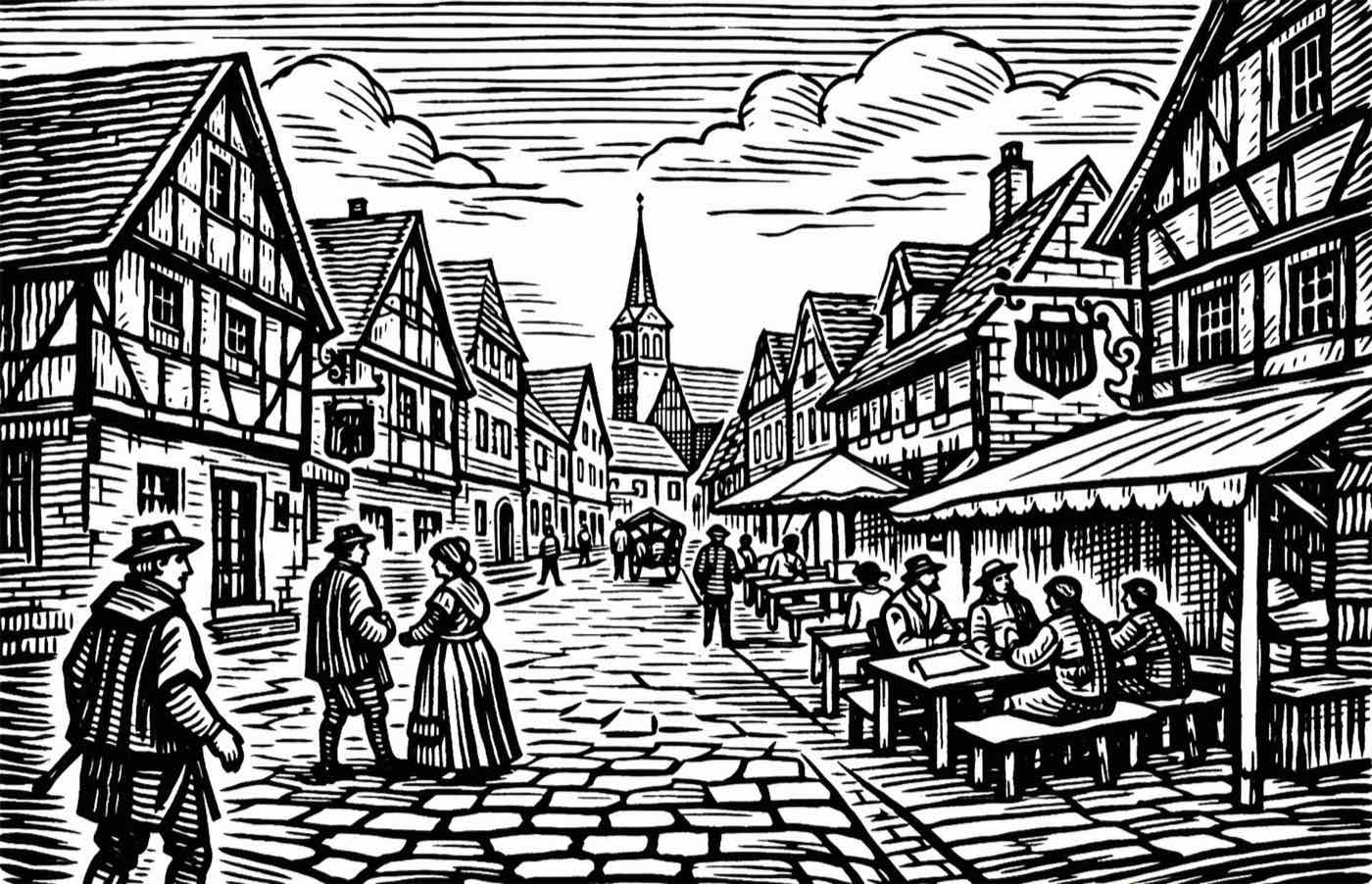
Slate, half-timbering, sandstone and varied facades do not create a uniform street view. The shifted building lines are also connected to Fürth's unusual history, with different spheres of authority shaping the old town side by side.
Transitions
As you walk, angles, building edges, entrances and small in-between spaces change quickly. The street feels compact, but still varied and close to everyday life.
Atmosphere
In summer, outdoor seating and movement shape the street scene; in winter, activity shifts more indoors. The area stays lively all year, but with a clearly different mood.
Offer diversity
From Franconian cuisine and international restaurants to bars, taverns, pubs and cafés, many different concepts are located side by side. This range makes Gustavstraße attractive for different preferences and occasions.
Overall impression
This creates a street space that never feels polished or interchangeable. Gustavstraße stays memorable because architecture, everyday use and social encounters directly overlap.
Impressions
Horizontal impressions from the street: continuous, direct and right in the center of Fürth's old town.
Did you take a great picture in Gustavstraße and want to share it with us?
If your photo fits the concept of this website, we are happy to include it in the gallery as part of the visual impressions.
By sending us your image, you agree that we may publish it in this gallery for an indefinite period of time.
Send photo via emailGustavstraße Today
Today, Gustavstraße Fürth is a daytime orientation point in the old town and one of the key evening meeting areas for gastronomy and going out.
Daytime
Between Rathaus, Waagplatz and Grüner Markt, many routes naturally pass through Gustavstraße. By day it is therefore not just scenery, but a practical route and place to stay.
Evening
In the evening, taverns, bars, pubs and restaurants move to the foreground. That is when you most clearly see why Gustavstraße is considered one of Fürth's key going-out areas.
Quarter
Debates about traffic, noise and quality of stay are therefore part of the place itself. The shift from former through-route to stronger place-to-stay shows that Gustavstraße is not viewed only as a tourist spot, but as a sensitive old-town quarter.
Meeting place
Different groups meet here: younger visitors, regulars, families, tourists and neighbors. This social mix keeps the area active and relevant.
This overlap of historic setting and current everyday life is exactly why Gustavstraße still matters so much in Fürth.
Events
Here you can quickly see the key events around Gustavstraße in Fürth. Tap any date to jump straight to the matching section with background, timing and official sources.
June 26-27, 2026
Market life
Grafflmarkt in Fürth is one of the best-known old-town formats around Gustavstraße, combining flea-market culture, social encounters and a historic urban backdrop.
Jump to event sectionJuly 3-4, 2026
Open-air culture
Grüne Nacht turns Grüner Markt right next to Gustavstraße into an atmospheric open-air stage with live music, food and a green-lit old-town backdrop.
Jump to event sectionExpected in 2027
Culinary experience
The wine festival at Gustavstraße in Fürth combines regional wine culture, historic old-town scenery and lively evening city life.
Jump to event sectionYear-round on request
Insider insights
Guided tours through Gustavstraße in Fürth make city history, tavern culture and architectural development tangible in one compact walk – including formats like “Secrets around Gustavstraße”, “Tavern Stories” and more.
Jump to event sectionLocation & orientation
The street is centrally located in Fürth's old town and easy to access on foot. Rathaus, Waagplatz and Grüner Markt are the key orientation points.
Public transport
Take U1 to Fürth Rathaus; several bus lines stop nearby.
By bike
Gustavstraße is easy to reach by bike, for example via Königstraße or through the Wiesengrund to the skate park and onward via Grüner Markt.
Parking
Inner-city parking garages are the practical option when arriving by car.
Best time
Daytime for old-town walks, evening for gastronomy and nightlife.
Use Fürth Rathaus as your target point
The Rathaus stop is the strongest transport anchor and a practical starting point.
Approach via Waagplatz or Marktplatz
From there, you enter the historic street corridor and the gastronomy core area directly.
Use the map filters by category
On the homepage map you can switch directly between restaurant, bar, tavern, pub and café.
To mapGustavstraße is part of a grown old-town heritage ensemble. It is best experienced as a place to stay, not only as a route through.
Stories & legends
Gustavstraße is shaped not only by buildings and venues, but also by narratives passed on locally. Some are well documented, others survive as legend.
Legend
"At the inn "Grüner Baum", King Gustavus Adolphus is said to have stayed overnight in 1632."
The story is still linked to Grüner Baum today, while local tradition also mentions the neighboring parish house as a possible location.
That ambiguity is exactly what makes the story meaningful: less a single proven fact, more a local memory that still shapes how the street is described.
Name history
"The former name "Bauerngasse" points to market and cart-traffic functions in old Fürth."
Local sources connect the former name to the quarter's earlier role in supply and trade routes.
The renaming took place in 1827. The older name shows that this area had long been a functional part of everyday urban life in Fürth, well before today's tavern profile: market activity, carts, inns and short routes between Grüner Markt, Waagplatz and taverns all belonged together.
Tavern culture
"For centuries, Gustavstraße has formed the core of Fürth's tavern scene."
In old-town life, inns were never only about food and drink; they also functioned as spaces for debate, associations and civic interaction.
This helps explain why Gustavstraße matters beyond gastronomy: tavern density here also reflects a long tradition of public social exchange.
Old-town tradition
"The first Fürth Grafflmarkt took place on June 7, 1975."
What began as a local Altstadtverein initiative has become a recurring highlight around Gustavstraße, Waagplatz and Grüner Markt.
For many people in Fürth and the surrounding region, Grafflmarkt is a fixed annual date. Since 1975, it has repeatedly made the old town visible as a lively public space. It also highlights how well this compact street-and-square structure works as a place to meet.
Behind the facades
"Courtyards and passages are part of what defines the quarter."
Part of the street's appeal appears only on a second look: in courtyards, short passages and side transitions into the surrounding quarter.
Guided walks often use this second layer to show that local history is not only written on facades, but also in transitions between street, courtyard and side lane. Examples such as Kannegießerhof and Schuhshof show how strongly former courtyard structures still shape the area.
Orientation & context
If you want to plan a focused visit to Gustavstraße Fürth, these six quick points give practical context without unnecessary detail.
Arrival
For first-time visits, Fürth Rathaus is the most practical starting point.
The easiest first entry point is Fürth Rathaus. From there, you reach Waagplatz, Grüner Markt and Gustavstraße in just a few minutes, directly in the core zone.
Density
The main gastronomy cluster is compact and easy to cover on foot.
The highest density sits around Gustavstraße and Waagstraße, where many restaurants, taverns, bars, pubs and cafés are within short walking distance.
Using the map
Two clicks are usually enough to turn a broad list into a useful shortlist.
On our interactive map, choose a category first and refine with tags if needed. This quickly narrows results, for example to taverns in Gustavstraße or calmer places for relaxation and exchange.
Timing
The same place feels very different depending on the time of day.
By day, the street feels calmer and more architectural; by evening, it becomes much livelier. Daytime works best for orientation and cityscape, evening for atmosphere and going out.
Quarter logic
Gustavstraße works as part of a connected old-town quarter, not as an isolated strip.
Routes, events and places to stay spread across adjacent squares. If you read Gustavstraße together with Waagplatz and Grüner Markt, the old-town structure becomes much clearer.
Urban space
Gustavstraße evolved from a traffic corridor into an area that is much more oriented toward staying and spending time.
Earlier, Gustavstraße was much more shaped by through-traffic, at times even in the context of the former B 8 route. Since the 1970s, traffic has gradually been reduced. With the 1988 "Kneipenstopp" development plan and the night driving ban introduced in 2024, the focus shifted further toward quality of stay, gastronomy and old-town compatibility.
For local venues
Do you run a venue around Gustavstraße? This is your direct entry point for listing and profile updates.
Focused entries
Urban life & debate
Since 2011, Gustavstraße has been the subject of repeated debate about closing times, noise protection and the role of gastronomy. This discussion is part of the street's recent history because it shows how closely old-town living, housing and going out are connected here.
Starting point
Gustavstraße is at once a residential street, a nightlife area, a historic old-town space and a destination for visitors. This density is what made noise, outdoor seating and night-time quiet such an important local issue for years.
Balancing interests
The discussion was not simply gastronomy versus residents. It was about how a lively old town can work when quality of stay, local businesses, cultural value and the need for quiet at night meet in the same compact place.
Today
The debate still shapes how the street is perceived today. Rules for outdoor gastronomy and the night-time traffic ban show that Gustavstraße is not treated as an interchangeable nightlife strip, but as a sensitive urban space.
Short overview
Context
For visitors, this matters because it explains why Gustavstraße is shaped and regulated so deliberately today. The street's appeal comes precisely from the fact that it is not only a gastronomy area, but part of a lived-in old town. A visit therefore means entering a place that may be lively, but also needs consideration and clear rules.
FAQ
Short answers to the questions that come up most often when visiting the street or using the map.
Gustavstraße is a historic street in Fürth Old Town and one of the city's best-known areas for gastronomy, urban culture and local history.
It is known for combining a historic old-town setting with a dense mix of restaurants, bars, taverns, pubs and cafés.
You can find restaurants, bars, taverns, pubs and cafés with different styles and cuisine profiles in Gustavstraße Fürth.
You can find an up-to-date overview of taverns in Gustavstraße in the interactive map. Simply choose the "Tavern" category to see all matching listings.
No. Gustavstraße is part of Fürth's heritage old-town ensemble and is used throughout the day for strolling, city visits and food culture.
Take U1 or local buses to Fürth Rathaus and continue on foot for a few minutes into Gustavstraße.
City-center parking garages are usually the most practical option. From there, the final part to Fürth Old Town is a short walk.
Daytime is great for old-town atmosphere and relaxed visits, while evenings are stronger for gastronomy, bars and social nightlife.
Recurring highlights include Grafflmarkt, Grüne Nacht, the wine festival and guided tours with a focus on tavern culture and city history.
Its cultural relevance comes from the overlap of historic building fabric, tavern culture and everyday public life. Few places in Fürth connect old-town image and gastronomy as directly as Gustavstraße does.
For a quick overview of places and categories, use the interactive map.
Open map